

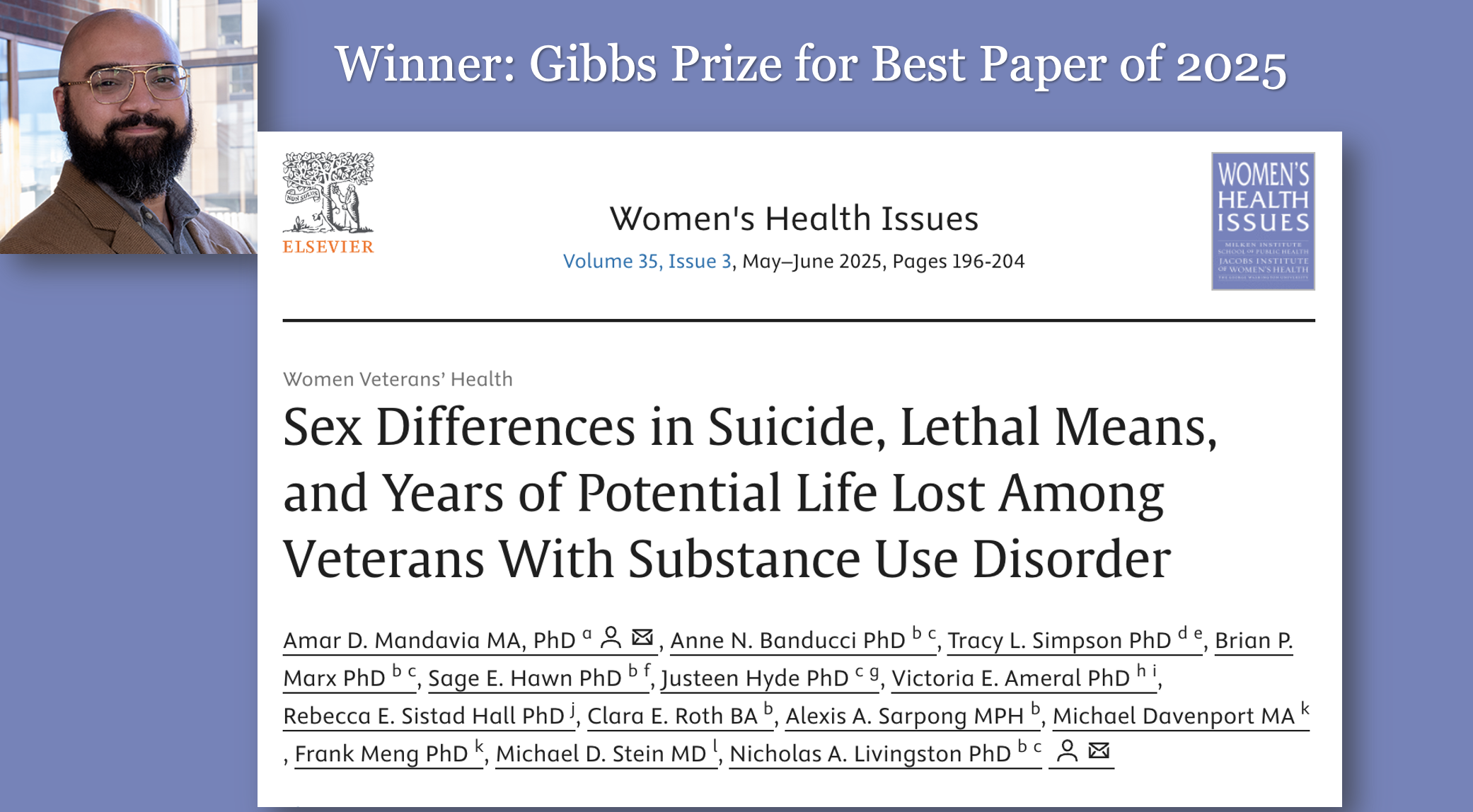
WASHINGTON, DC (February 4, 2026)—The Editorial Board of Women’s Health Issues is pleased to announce that the Charles E. Gibbs Leadership Prize for the best paper published in Women's Health Issues in 2025 (Volume 35) has been awarded to Amar D. Mandavia, MA, PhD, of VA Boston Healthcare System and Boston University Chobanian & Avedisian School of Medicine. His article, “Sex Differences in Suicide, Lethal Means, and Years of Potential Life Lost Among Veterans With Substance Use Disorder,” was published in Women’s Health Issues Volume 35, Issue 3 (May/June 2025).
Mandavia and colleagues used data from a cohort of more than 100,000 veterans with alcohol use disorder and/or opioid use disorder who had received Veterans Health Administration care and died between 2016 and 2020. They identified more than 5,000 veterans in the cohort who died of suicide, and within this group they compared both the age of death and the mechanisms of suicide for men and women.
The authors found that women veterans were more than twice as likely as their male counterparts to die by suicide, and they died at significantly younger ages. For men, suicide deaths accounted for 21 years of potential life lost; for women, the toll was 32 lost years. Although intentional poisoning was the most common means of suicide death for both men and women, women were twice as likely to die by poisoning-related suicide. Given that many poisoning deaths involve prescribed drugs, the authors note that prescribing interventions are possible but that “strategies must strike a careful balance between ensuring access to needed medications for psychiatric disorders while reducing the overall available quantity of potentially fatal medications.”
“Our editorial board appreciated this study because not only is it methodologically strong, it also presents findings that are timely, actionable, and relevant,” said Karen McDonnell, Editor-in-Chief of Women’s Health Issues. “These findings can help improve care for women veterans with substance use disorders.”
Out of the 51 research articles published in Women’s Health Issues in 2025, 48 were eligible for prize consideration because they did not have editorial board members as authors. The Editorial Board also designated four of the eligible 2025 manuscripts to receive “Honorable Mention” recognition:
- “Impacts of Medicaid Expansion on Contraceptive Use Among Women in Neighborhoods of Racialized Socioeconomic Deprivation in the United States” by Alice F. Cartwright, PhD, MPH, Gustavo Angeles, PhD, Jessica Su, PhD, Maeve Wallace, PhD, MPH, Siân Curtis, PhD, and Ilene S. Speizer, PhD. Published in Volume 35, Issue 5 (September/October 2025).
- “Demand for Medication Abortion Through Telehealth Before and After the Dobbs v. Jackson Supreme Court Decision in States Where Abortion Is Legal” by Anna E. Fiastro, PhD, MPH, MEM, Elissa Brown, MPH, Rebecca Gomperts, MD, MPP, PhD, and Emily M. Godfrey, MD, MPH. Published in Volume 35, Issue 5 (September/October 2025).
- “Military Exposures and Early Menopause: Findings From the Gulf War Era Cohort Study (GWECS)” by Carolyn J. Gibson, PhD, MPH, Guichan Cao, MS, Sabra Inslicht, PhD, Allison D. Altman, PhD, Caitlin E. Haas, BS, BA, Aaron Schneiderman, PhD, MPH, RN, and Erin Dursa, PhD, MPH. Published in Volume 35, Issue 4 (July/August 2025).
- “Contribution of Maternal Age to Increasing Severe Maternal Morbidity During Birth and Up to 1 Year Postpartum” by Samuel H. Nyarko, PhD, Lucy T. Greenberg, MS, Scott A. Lorch, MD, Jeannette Rogowski, PhD, Jeffrey S. Buzas, PhD, Ciaran S. Phibbs, PhD, George R. Saade, MD, Molly Passarella, MS, and Nansi S. Boghossian, MPH, PhD. Published in Volume 35, Issue 6 (November/December 2025).
The Charles E. Gibbs Leadership Prize is awarded annually to recognize excellence in research on women’s health care or policy. Priority is given to manuscripts that report the results of original research and that improve understanding of an important women’s health issue. Members of the staff and Editorial Board of Women’s Health Issues are not eligible.
Previous winners of the Gibbs Prize are:
Monica H. Keith, PhD (2024): Social Determinant Pathways to Hypertensive Disorders of Pregnancy Among Nulliparous U.S. Women
Godwin K. Osei-Poku, MD, DrPH (2023): Risk of Severe Maternal Morbidity in Birthing People With Opioid Use Disorder
Sarah A. White, MSPH (2023): Implementation of State Laws Giving Pregnant People Priority Access to Drug Treatment Programs in the Context of Coexisting Punitive Laws
Sara K. Redd, PhD, MSPH (2022): Variation in Restrictive Abortion Policies and Adverse Birth Outcomes in the United States from 2005 to 2015
Anu Manchikanti Gomez, PhD, MSc (2021): "It’s Being Compassionate, Not Making Assumptions": Transmasculine and Nonbinary Young Adults’ Experiences of ‘Women’s’ Health Care Settings
Willi Horner-Johnson, PhD (2021): Preconception Health Risks Among U.S. Women: Disparities at the Intersection of Disability and Race or Ethnicity
Erica L. Eliason, MPH (2020): Adoption of Medicaid Expansion is Associated with Lower Maternal Mortality
Sarah C.M. Roberts, DrPH (2019): State Policies Targeting Alcohol Use during Pregnancy and Alcohol Use among Pregnant Women 1985–2016: Evidence from the Behavioral Risk Factor Surveillance System
Emily M. Johnston, PhD (2018): Impacts of the Affordable Care Act’s Medicaid Expansion on Women of Reproductive Age: Differences by Parental Status and State Policies
Soumitra S. Bhuyan, PhD, MPH (2017): Does Cost-Related Medication Nonadherence among Cardiovascular Disease Patients Vary by Gender? Evidence from a Nationally Representative Sample
Maeve Ellen Wallace, PhD (2017): The Status of Women's Reproductive Rights and Adverse Birth Outcomes
Aimee Kroll-Desrosiers, MS (2016): Receipt of Prescription Opioids in a National Sample of Pregnant Veterans Receiving Veterans Health Administration Care
Miao Jiang, PhD (2015): Screening Mammography Rates in the Medicare Population before and after the 2009 U.S. Preventive Services Task Force Guideline Change: An Interrupted Time Series Analysis
Hailee K. Dunn, MPH (2014): Association between Sexual Behaviors, Bullying Victimization and Suicidal Ideation in a National Sample of High School Students: Implications of a Sexual Double Standard
Cynthia LeardMann, MPH (2013): Combat Deployment Is Associated with Sexual Harassment or Sexual Assault in a Large, Female Military Cohort
Nathan L. Hale, PhD (2012): Postpartum Screening for Diabetes among Medicaid-Eligible South Carolina Women with Gestational Diabetes
Jacqueline L. Angel, PhD (2011): A Window of Vulnerability: Health Insurance Coverage Among Women 55 to 64 Years of Age
Diana Greene Foster, PhD (2010): Should Providers Give Women Advance Provision of Emergency Contraceptive Pills? A Cost-Effectiveness Analysis
Paula Lantz, PhD (2009): An Evaluation of A Medicaid Expansion for Cancer Care: The Breats and Cervical Cancer Prevention and Treatment Act of 2000
Sherry Glied, PhD (2008): Women’s Health Insurance Coverage 1980–2005
Richard C. Lindrooth, PhD (2007): The Effect of Medicaid Family Planning Expansions on Unplanned Births
Joan S. Tucker, PhD (2006): Cigarette Smoking from Adolescence to Young Adulthood: Women's Developmental Trajectories and Associated Outcomes
JiWon R. Lee, MS, RD, MPH (2005): The Association Between Educational Level and Risk of Cardiovascular Disease Fatality among Women with Cardiovascular Disease
Dawn M. Upchurch, PhD (2004): Associations between Forced Sex, Sexual and Protective Practices, and Sexually Transmitted Diseases among a National Sample of Adolescent Girls
Sherry L. Grace, PhD (2003): Presentation, Delay, and Contraindication to Thrombolytic Treatment in Females and Males with Myocardial Infarction
Sarah Hudson Scholle, DrPH (2002): Trends in Women's Health Services by Type of Physician Seen: Data from the 1985 and 1997-98 NAMCS
Sandra K. Pope, PhD (2001): Functional Limitations in Women at Midlife: The Role of Health Conditions, Behavioral and Environmental Factors
Ilene Hyman, PhD (2000): Primary Prevention of Violence Against Women
Usha Sambamaoorthi, PhD (1999): Estrogen Replacement Therapy Among Elderly Women: Results from the 1995 Medicare Current Beneficiary Survey
Claire Murphy, MD (1997): A New Model of Training Physicians and Health Care Professionals in Women's Primary Health Care: The Women's Health Scholar Program
Barbara A. Bartman, MD, MPH (1996): Women's Access to Appropriate Providers within Managed Care: Implications for the Quality of Primary Care
The Charles E. Gibbs Leadership Prize was established to honor the founding President of the Board of Governors of the Jacobs Institute of Women’s Health. Charles E. Gibbs, MD (1923–2000) was a Fellow of the American Congress of Obstetricians and Gynecologists (ACOG) and past chair of ACOG’s Committee on Health Care for Underserved Women, the Task Force on the Voluntary Review of Quality of Care, the Health Care Commission, and the Task Force on Maternal Health Policy. Dr. Gibbs served on the Jacobs Institute of Women’s Health Board of Governors from 1990–1999 and was instrumental in shaping the Institute’s mission and structure.